Water Well Drilling Work Success from Site Selection to First Water?
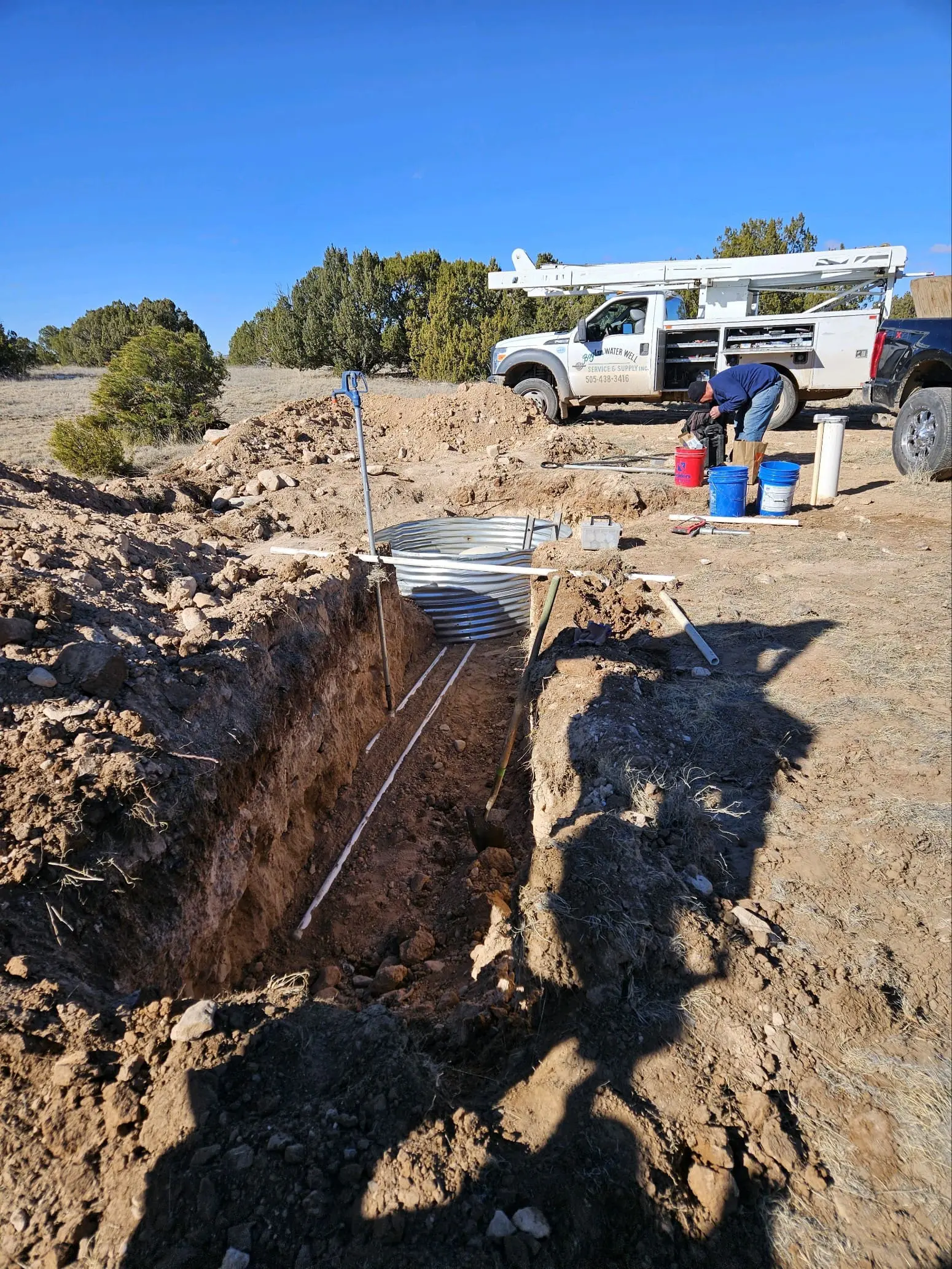 Drilling a water well involves much more than making a hole in the ground. Before a new well can supply water to a home, the property must be evaluated, the necessary permits obtained, groundwater reached, and the well properly constructed and tested.
The water well drilling process begins with site selection and permitting, followed by drilling through soil and rock to reach groundwater. Once water is found, the well must be completed, developed, evaluated for production, and connected to a suitable pump system. Water quality must also be tested before the water is considered safe to drink.
For property owners in Santa Fe and Northern New Mexico, understanding these steps helps establish realistic expectations about drilling depth, groundwater availability, construction requirements, and when a new well will be ready for use.
Before Drilling: Evaluate the Property and Choose a Well Location
The first step is determining where a water well can be safely and legally constructed.
A suitable drilling location must account for underground water conditions, property boundaries, potential contamination sources, and access for heavy equipment.
In Northern New Mexico, groundwater conditions can change significantly between properties. One location may have groundwater in fractured bedrock, while another may depend on water-bearing layers of sand or gravel.
A nearby well can provide useful information about local groundwater conditions, but it does not guarantee that a new well will produce the same amount of water.
What Determines Where a Water Well Can Be Drilled?
Several factors influence the proposed location:
- Groundwater conditions: Available geological information and nearby well records can help identify possible water-bearing formations.
- Property layout: Buildings, septic systems, property boundaries, and other site features may restrict drilling locations.
- Equipment access: Drilling rigs and support vehicles need enough space to enter, operate, and leave the property safely.
- Potential contamination: The location must account for applicable separation requirements from septic systems and other pollution sources.
- Future maintenance: The completed wellhead should remain accessible for inspections, pump replacement, and repairs.
Selecting a location involves balancing groundwater potential with legal requirements and practical construction considerations.
Property owners can learn more about these decisions in our guide to finding the best place to drill a water well.
- Can You Drill a Water Well Anywhere on Your Property? — Property restrictions and drilling locations.
Check New Mexico Well Permits Before Drilling
New Mexico regulates groundwater use through the Office of the State Engineer (OSE).
Before drilling, property owners must determine which groundwater permit or authorization applies to their proposed well. The requirements depend on factors such as the intended water use, location, and applicable water rights.
A domestic household well may follow a different permitting process than a well intended for commercial irrigation or other uses.
The New Mexico Office of the State Engineer provides information about groundwater administration and permitting.
Property owners should confirm the applicable requirements before scheduling drilling. A drilling contractor can help explain the construction process, but responsibility for applications and supporting documentation should be established in advance.
Prepare the Site and Bring in Drilling Equipment
Once the proposed location and necessary authorizations are established, the property must be prepared for drilling.
Water well drilling equipment is large and heavy. The site needs sufficient room for the drilling rig, support vehicles, tools, and materials.
Preparation may involve clearing vegetation, identifying underground utilities, evaluating the access road, and arranging a suitable work area.
On rural properties around Santa Fe, Pecos, Glorieta, and other mountain communities, steep terrain or narrow access roads can affect equipment placement.
The drilling contractor also needs to account for the soil, rock, and groundwater conditions expected at the site.
What Equipment Is Used to Drill a Water Well?
Many water wells are constructed using rotary drilling equipment.
A rotary drilling rig turns a drill bit that cuts or breaks through underground materials. Depending on the drilling method, air or drilling fluid helps remove cuttings from the borehole.
The equipment and techniques selected depend on the geological formations and the construction requirements of the well.
Boylan Water Well Service & Supply uses rotary drilling equipment as part of its water well services throughout Northern New Mexico.
Drill Through Soil and Rock to Reach Groundwater
With the drilling rig positioned, drilling begins at the approved location.
The drill bit advances through underground layers that may include loose soil, sand, gravel, sedimentary rock, or harder bedrock.
These materials affect how quickly drilling progresses and which construction methods are appropriate.
In some formations, the borehole may require temporary or permanent casing as drilling advances. Other formations may remain stable enough for different construction approaches.
The drilling process creates a borehole that extends toward underground water-bearing formations.
How Does a Driller Know When Groundwater Has Been Reached?
Drillers monitor the materials and conditions encountered as the borehole advances.
Signs of groundwater can include water entering the borehole, changes in drilling returns, or other indications associated with the drilling method.
However, the presence of groundwater does not necessarily mean the well will produce enough water for a household.
The amount of water available depends on the characteristics of the underground formation and how readily groundwater can move toward the well.
This distinction becomes especially important in fractured rock formations, where water production may depend on the size and connectivity of underground fractures.
What Happens When the Drill First Reaches Water?
Finding water is an important milestone, but first water does not mean the well is finished or ready to supply a home.
When groundwater enters the borehole, the driller evaluates the conditions and determines whether additional drilling or construction work is necessary.
The first water-bearing formation encountered may produce only a limited amount of water. Deeper formations may offer different production potential, although drilling farther does not guarantee a better result.
Three separate milestones help explain what happens next.
| Milestone | What it means |
| First water encountered | Groundwater has entered the borehole, but its usable production has not yet been established. |
| Well production evaluated | Development and appropriate testing help determine how much water the completed well can supply. |
| Water ready for intended use | Construction, equipment installation, water-quality testing, and other necessary steps have been completed. |
A property owner should not assume that seeing water at the drilling site means the new well can immediately serve a home.
Install Well Casing and Complete the Well
After drilling reaches the planned depth, or as construction proceeds, the well must be completed to protect its structure and groundwater supply.
Well casing is a pipe installed in the borehole to support the well and help prevent unwanted materials from entering.
Depending on the geology and well design, casing may extend through the entire well or only through selected sections.
In unconsolidated formations, well screens may also be installed to allow groundwater to enter while limiting the movement of sand and other particles.
Why Are Well Casing and Sealing Important?
Proper casing and sealing help protect the water supply from contamination.
An annular seal is placed in the space between the casing and the surrounding borehole where required by the well design and applicable construction rules.
Its purpose is to help prevent water from moving downward along the outside of the casing and carrying contaminants into groundwater-bearing formations.
The wellhead must also be properly finished and protected from surface water, debris, and other contamination sources.
Construction details depend on the geological conditions and New Mexico’s applicable well construction requirements.
Develop the Well and Evaluate Water Production
A newly drilled well may contain fine sediment, drilling residue, and other materials left behind during construction.
Well development is the process of removing these materials and improving the movement of groundwater into the well.
Depending on the well design, development may involve pumping, surging, airlifting, or other professional methods.
This work helps clear the well and allows its production characteristics to be evaluated more accurately.
- Can a Residential Well Run Dry? — Groundwater production and long-term supply.
How Is Well Yield Determined?
Well yield describes the rate at which water can be produced from a well, commonly expressed in gallons per minute (GPM).
During a pumping evaluation, the contractor may measure the amount of water produced and observe how the water level responds.
Two important measurements are:
- Static water level: The groundwater level in the well when it is not being pumped and has had time to recover.
- Pumping water level: The water level while the well is producing water.
The difference between these measurements is called drawdown.
A well that produces water rapidly for a short period may not sustain that production over a longer period. Water-level recovery and the response to continued pumping provide additional information about its performance.
The results help determine whether the well can meet the property’s expected water demand and what type of pump or storage arrangement may be appropriate.
What Happens If a New Well Produces Less Water Than Expected?
A low-producing well does not always mean the property has no usable groundwater.
Depending on the circumstances, the contractor may evaluate additional development, different pump operating rates, water storage, or other options.
For example, a household with a relatively low-yield well may be able to use a storage tank to accumulate water gradually and a separate pressure system to meet periods of higher demand.
Whether that approach is practical depends on the well’s actual production, water requirements, and system design.
Test Water Quality and Prepare the Pump System
Once the well has been constructed and its production evaluated, attention turns to water quality and the equipment needed to deliver water.
Groundwater may appear clear while containing bacteria, dissolved minerals, or naturally occurring contaminants that cannot be identified by sight, smell, or taste.
New well water should be tested by an appropriate laboratory before it is used for drinking.
The New Mexico Environment Department provides private-well water-quality information and testing resources.
Testing needs depend on the location, intended use, and potential contamination concerns. Common considerations include coliform bacteria, nitrate, arsenic, and other constituents relevant to local groundwater conditions.
Any necessary disinfection, treatment, or follow-up sampling should be completed according to applicable professional and public-health guidance.
- How Can I Protect My Water Well from Contamination and Bacteria? — Water-quality protection.
How Is a Pump Installed in a New Water Well?
A submersible pump is commonly used in residential wells.
The pump is lowered into the well and connected to piping and electrical equipment that deliver groundwater to the surface.
Pump selection depends on several factors, including the well’s tested production, pumping water level, required pressure, elevation changes, and household demand.
A typical residential water system may include a submersible pump, drop pipe, electrical controls, a pressure tank, and distribution piping.
Some properties also require water storage, booster pumps, filtration, or other equipment.
Boylan Water Well Service & Supply provides pump installation, pressure tanks, water storage, and complete water system services for residential and rural properties throughout Northern New Mexico.
When Is a New Water Well Ready for Household Use?
A water well is ready for household use only after the required construction and system work has been completed and its water supply is appropriate for the intended use.
Before relying on a new well, property owners should understand the status of several important items.
| Project stage | What the property owner should confirm |
| Permitting | Required authorizations were obtained and applicable documentation is complete. |
| Well construction | Casing, sealing, and wellhead construction have been completed appropriately. |
| Development and testing | Water production has been evaluated and the results explained. |
| Water quality | Appropriate laboratory testing has been completed and any necessary treatment addressed. |
| Pump installation | The pump, pressure equipment, and controls have been installed and tested. |
| Household connection | The distribution system is connected and operating properly. |
A well may be physically complete while the pump installation, laboratory results, or household plumbing connection is still pending.
Understanding which stage has been completed helps property owners plan construction schedules and avoid assuming that groundwater discovery means water service is immediately available.
Questions to Ask Before Scheduling Water Well Drilling
Property owners can prepare for a drilling consultation by gathering information about their land and asking questions about the work ahead.
Useful questions include:
- What groundwater information is available for nearby properties, and what are its limitations?
- What permits or authorizations are required for my intended water use?
- Where can drilling equipment safely access the property?
- What geological conditions could affect drilling and well construction?
- How will the completed well’s water production be evaluated?
- What happens if the well produces less water than expected?
- Which construction, testing, pump installation, and water-system services are included in the estimate?
- What documentation and test results will I receive when the project is finished?
These questions help clarify the scope of work, responsibilities, and decisions that may arise during construction.
How Long Does Water Well Drilling Take?
There is no single drilling schedule that applies to every property.
The time required depends on permitting, equipment access, geological conditions, drilling depth, construction requirements, and whether additional work is needed.
Drilling through hard rock can present different challenges than drilling through loose sediment. Unexpected underground conditions may also change the planned approach.
The drilling itself is only one part of the project. Well development, production testing, pump installation, water-quality testing, and final connections can extend the overall schedule.
A contractor can provide a project-specific estimate after reviewing the property and proposed work.
Planning a New Water Well in Northern New Mexico
A successful water well project depends on more than reaching groundwater. Proper site planning, construction, water production evaluation, and equipment selection all contribute to a reliable long-term water supply.
For property owners in Santa Fe and surrounding Northern New Mexico communities, local geological knowledge is particularly important because groundwater conditions vary considerably across the region.
Boylan Water Well Service & Supply provides water well drilling, pump installation, water storage, and water system services for residential, agricultural, and commercial properties.
If you are planning a new well, contact Boylan to discuss your property, drilling access, groundwater considerations, and the next steps in the process.
Call (505) 438-3416 or visit Boylan Water Well Service & Supply to discuss your water well project.