Where Should a New Water Well Be Located in New Mexico?
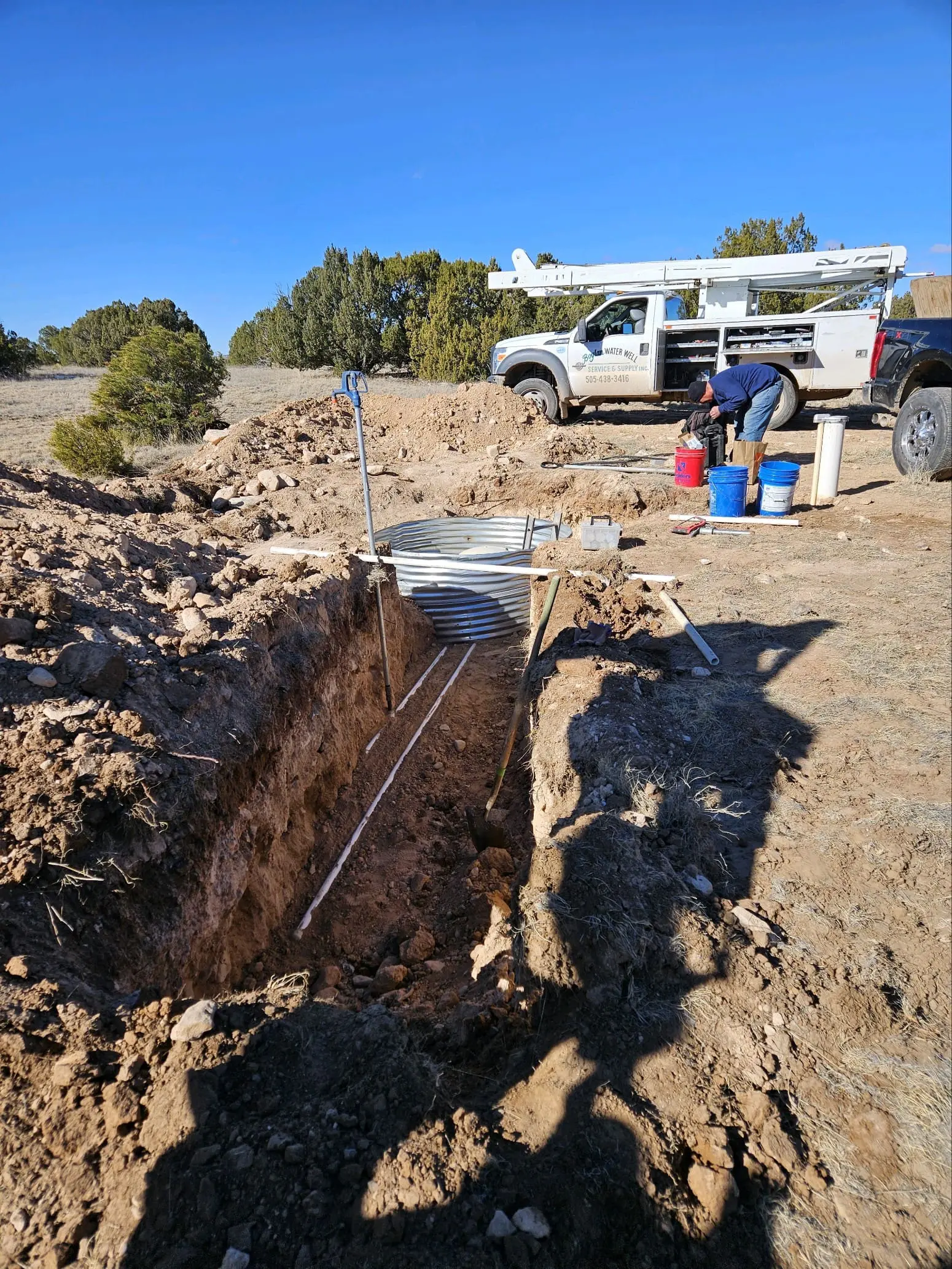 The best location for a new water well in New Mexico is a site that first clears applicable legal and contamination setbacks, then makes sense for groundwater conditions, drilling access, future maintenance and the complete water-delivery system. The most convenient spot – or the spot closest to the house – is not automatically the best place to drill.
Before drilling, the proposed location should be reviewed against the property layout, the issued well permit and current state requirements. New Mexico’s Office of the State Engineer (OSE) regulates domestic-well permitting and well construction, while the New Mexico Environment Department (NMED) establishes separation requirements for onsite liquid-waste systems such as septic tanks and disposal fields. A licensed New Mexico well driller can also evaluate whether a location is practical for the drilling rig and for long-term well service.
That combination matters in Northern New Mexico, where a rural parcel may include a home site, septic system, driveway, utility trenches, fences, livestock areas, slopes, arroyos and future building plans – all competing for space.
Start With the Locations You Cannot Use
A useful way to choose a well site is to eliminate unsuitable locations before comparing the remaining options. Regulatory setbacks, contamination sources, access restrictions and property constraints should be addressed early, because moving a proposed well on a site plan is far easier than dealing with a poorly located well after it has been drilled.
Existing and Neighboring Wells
Under New Mexico’s Domestic Well Rules, a new domestic well is generally required to be set back at least 50 feet from an existing well owned by another person. The OSE’s consumer guidance repeats that minimum and advises property owners to review additional setback requirements before drilling.
The 50-foot rule should not be treated as the only siting requirement. Permit conditions, the property’s legal configuration and other water or wastewater features can affect the final location. New Mexico’s current Domestic Well Rules and the OSE water-rights rules and guidelines should be checked for the current requirements that apply to the project.
Septic Tanks, Disposal Fields and Other Contamination Sources
On many rural properties, the well and septic system need to be planned together. New Mexico’s liquid-waste rules establish different minimum distances between a private drinking-water well and different parts of an onsite wastewater system. Under the current Table 302.1, the minimum separation is 50 feet from a treatment unit such as a septic tank and 100 feet from a disposal field or seepage pit. A private well also has a 50-foot separation from a building sewer under that table.
Those are regulatory minimums, not a promise that every site meeting the minimum is automatically the best location. Site conditions, treatment type, variances, groundwater concerns and other features can change what is appropriate or permitted. When a home, well and septic system are all being planned, lay them out together before either system is installed.
For the current setback table and its exceptions, review 20.7.3 NMAC, New Mexico’s Liquid Waste Disposal and Treatment rules.
Easements, Utilities, Overhead Power and Future Construction
A proposed well site also has to work above ground. The OSE’s well-drilling guidance specifically tells property owners to consider fences, trees, overhead power lines, site leveling and future access to the well. Buried utilities, easements, driveways and planned structures should be mapped before equipment is mobilized.
Think beyond today’s property layout. A well that sits neatly in an open area now could interfere with a future garage, barn, addition, driveway or septic replacement area. The goal is to protect both the well and the property’s future flexibility.
How Do Groundwater and Geology Affect the Well Location?
A well location has to make sense underground as well as above ground, but groundwater cannot be guaranteed from surface appearance. Northern New Mexico has highly variable geology. Bedrock, fractured rock, sand, gravel, clay and changes in aquifer depth can occur over relatively short distances.
Nearby well records and regional groundwater information can help provide context, but a productive neighboring well does not guarantee the same depth or yield on your parcel. Groundwater potential is only one part of the siting decision, and it should never be treated as a promise that a particular point will produce a certain amount of water.
Boylan’s existing article on dry-hole risk when drilling a Santa Fe well explains why drilling always carries geological uncertainty. That is also why site selection should be based on available information and practical constraints rather than a guarantee of water production.
How Much Room Does a Water Well Drilling Rig Need to Reach the Site?
A proposed location is not useful if the drilling equipment cannot safely reach and work at the site. Water-well drilling uses large, heavy equipment, along with support vehicles, drill pipe, casing and other materials. The route to the drilling point matters almost as much as the point itself.
Before settling on a location, consider the width and condition of gates and access roads, sharp turns, steep grades, soft ground, trees, fences and overhead utilities. A driller also needs enough working room to operate the rig and handle pipe safely. Exact clearance needs depend on the equipment and the site, so avoid assuming a fixed pad dimension without asking the contractor who will perform the work.
Access can also affect project cost. A site that is difficult to reach may require clearing, grading, fence removal or other preparation before the rig can be positioned.
Why Future Access Matters After the Well Is Drilled
The drilling rig is not the last piece of large equipment that may need to reach the well. Pumps eventually require service. A pump may need to be pulled from the well, the well may need to be inspected or rehabilitated, and service vehicles may need room near the wellhead.
That makes access a lifecycle issue. Hiding a well behind permanent landscaping, enclosing it with a structure or blocking it with a future addition can make routine service much more difficult. A good location leaves the wellhead identifiable, protected and reasonably accessible years after construction.
Should the Well Be Close to the House?
A shorter distance between the well and the home can reduce trenching and simplify some parts of the water-line and electrical installation. But ‘closest to the house’ is only one design preference, not the controlling rule.
Suppose one possible site is close to the home but conflicts with the septic disposal area and sits below overhead power lines. A second site is farther away but clears the required setbacks, provides better equipment access and fits the planned water-system layout. The longer trench may be the better overall choice.
The well should therefore be planned as part of the complete system: the borehole, pump, drop pipe, electrical controls, pressure tank, water line and, when appropriate, storage or booster equipment.
For more on the full installation rather than site selection alone, see Boylan’s step-by-step domestic water well drilling process.
How Do Slope, Drainage and Surface Runoff Affect Well Siting?
Surface drainage deserves attention even though it does not tell you how deep groundwater is. The wellhead should be protected from conditions that can direct contaminated surface water toward the casing. Low areas that collect runoff, areas affected by erosion, and locations near potential contamination sources deserve careful review.
In the high-desert environment of Santa Fe and Northern New Mexico, intense summer storms can move a surprising amount of water across a property in a short time. Snowmelt can also expose drainage patterns that are not obvious during dry weather. The site plan should account for how water moves across the ground, not just how the parcel looks on a clear day.
Boylan’s guidance on protecting a private well from contamination provides additional context on runoff, septic systems and other sources that can affect groundwater protection.
How Should the Well Location Fit the Pump, Pressure Tank, Storage and Electrical Plan?
A water well is not simply a hole in the ground. It is the source for a complete water-delivery system. Boylan’s company materials identify drilling, pump installation, pressure tanks, storage systems, controls, water lines and ongoing service as connected parts of that system.
Before drilling, consider where the water line will run, how electrical power will reach the well, where the pressure tank and controls will be located, and whether the property may need water storage or a booster system. Long trench runs are not automatically wrong, but they should be part of the design and budget rather than a surprise after drilling.
If budget planning is part of the decision, Boylan’s article on the cost of drilling a new water well in New Mexico explains how depth, geology, equipment, electrical work, trenching and accessibility can influence the total project.
A Three-Gate Test for Comparing Possible Well Locations
When two or three locations appear possible, compare them in this order:
| Gate | Question | What to Check |
| 1. Legal and protective | Can the site legally and safely be used? | OSE permit conditions; neighboring wells; septic and liquid-waste setbacks; contamination sources; easements; property constraints. |
| 2. Drill and service access | Can equipment reach and work at the site now and later? | Roads and gates; slope; trees and fences; overhead utilities; working room; future pump-pulling and service access. |
| 3. Complete-system fit | Does the location make sense for the whole water system? | Groundwater/geology context; house connection; trenching; electrical route; pressure tank; storage; future buildings and property use. |
A location that fails the first gate should not become the favorite simply because it is convenient. A location that passes the regulatory checks but creates serious access problems may also deserve reconsideration. The strongest candidate is the one that works across all three.
What Should I Have Ready Before a Well Driller Visits the Property?
You do not need to design the well yourself, but a little preparation makes the site discussion more productive. Have the parcel information and any existing site plan available. Mark or identify the proposed house, septic tank and disposal area, property lines, easements, utilities, roads, gates, overhead lines, existing wells, drainage features and any planned future structures.
Also be ready to explain the intended water use. A single residence, ranch, livestock operation, irrigation use or commercial property may have different water demands and permitting considerations.
If the permit process is still unclear, review What Permits Are Required Before Drilling a New Water Well in New Mexico? before the rig is scheduled. The OSE also advises consumers that well construction must be performed by a New Mexico-licensed well driller, subject to the applicable rules and permit conditions.
Frequently Asked Questions
Where is the best place to drill a well on my property?
The best location is a site that satisfies applicable setbacks and permit conditions, has reasonable groundwater potential, can be reached by drilling and future service equipment, and fits the complete water-system layout. Convenience alone should not determine the location.
How far must a new domestic well be from a neighbor’s well in New Mexico?
New Mexico’s Domestic Well Rules generally require a new domestic well to be at least 50 feet from an existing well owned by another person. Always verify the current rule and the conditions on the specific permit before drilling.
How far should a private well be from a septic system in New Mexico?
Under current New Mexico liquid-waste rules, a private drinking-water well generally has a 50-foot minimum separation from a treatment unit such as a septic tank and a 100-foot separation from a disposal field or seepage pit. Other components and special circumstances have their own requirements, so the current NMED rule and site-specific approvals should control the final layout.
Does my new well need to be close to the house?
No. A closer well can reduce some trenching, but it must still clear the applicable setbacks and work for drilling access, utilities, drainage, future service and the complete water system. A somewhat farther location can be the better long-term choice.
Can a well driller guarantee water at a specific location?
No drilling location can eliminate geological uncertainty. Nearby wells and groundwater records can provide useful information, but aquifer depth and water production can vary between properties. Avoid any site-selection decision based on a guaranteed yield unless that claim is supported by an enforceable project-specific agreement and reliable evidence.
Can I choose the well location before I get the permit?
You can identify a proposed location during planning, but the final drilling point should be consistent with the issued permit, current setback requirements and other applicable approvals. Do not treat a preliminary mark on the ground as final authorization to drill.
Plan a New Water Well with Boylan Water Well Service & Supply
A good well location is the result of planning, not simply picking an open patch of ground. Regulatory setbacks, groundwater conditions, drilling access, future maintenance and the rest of the water system all need to work together.
Boylan Water Well Service & Supply provides water well drilling and complete water-system services for homeowners, ranches, agricultural properties and businesses throughout Santa Fe and Northern New Mexico. Its work spans new well construction, pump systems, pressure tanks, storage and long-term water-system service.
If you are planning a new well, contact Boylan Water Well Service & Supply to discuss your property, proposed water use, site access and water-system needs.
Boylan Water Well Service & Supply
2743 Boylan Circle, Space 11
Santa Fe, New Mexico 87507
(505) 438-3416
Sources and Regulatory References
New Mexico Office of the State Engineer – Drilling Your Water Well – Consumer guidance on permits, licensed well drillers, physical site obstacles, future access and the 50-foot setback from an existing well of other ownership.
New Mexico Domestic Well Rules, 19.27.5 NMAC – Current state rule governing domestic-well permits and conditions, including the neighboring-well setback and licensed-driller requirement.
New Mexico Liquid Waste Disposal and Treatment Rules, 20.7.3 NMAC – Current NMED setback table and requirements affecting private drinking-water wells and onsite liquid-waste systems.
New Mexico Office of the State Engineer – Water Rights Rules and Guidelines – Official access point for current domestic-well and water-rights rules and guidance.
Boylan Water Well Service & Supply – Our Services – Company service information for well drilling and related water-well services.